


![Philippine Defense Secretary Gilberto Teodoro Jr. (R) shakes hands with Canadian Minister of Defense David McGuinty as they hold the signed agreement on visiting forces after their meeting in Manila on November 2. [Ted Aljibe/AFP]](/gc9/images/2025/11/12/52747-afp__20251102__82r47zr__v1__highres__philippinescanadadiplomacy-370_237.webp)
By Shirin Bhandari |
The Philippines and Canada signed a Status of Visiting Forces Agreement (SOVFA) in early November, marking a new phase in their defense cooperation and reinforcing coordination amid escalating tensions in the South China Sea.
China claims more than 80% of that sea as its territory, even though an international court rejected that view in 2016.
Negotiations on the SOVFA took about a year, the Diplomat reported.
Philippine Defense Secretary Gilberto Teodoro Jr. and Canadian Defense Minister David McGuinty signed the agreement in Makati, the Philippines. The pact establishes the legal foundation for Canadian troops to participate in military training, exercises and cooperative activities within the Philippines. It facilitates reciprocal deployments in Canada.
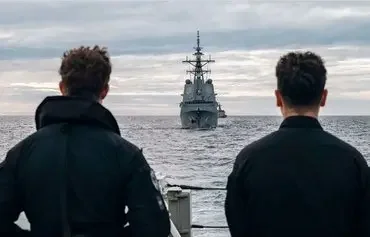
In a statement, Ottawa said the agreement "marks a new chapter in Canada-Philippines defense cooperation, enabling greater engagement, cooperation, and collaboration between both nations."
An expansion of cooperation
The pact builds on the already "robust" information-sharing and people-to-people ties between the two countries, said Teodoro.
The agreement's value extends beyond joint exercises, he said. "Beyond this agreement, we recognize its strategic value of expanding cooperation in maritime security, humanitarian assistance, disaster response, [and] cyber defense capability," Teodoro said.
The signing took place against the backdrop of China's increased activities in disputed waters. In recent months, China Coast Guard (CCG) vessels have rammed Philippine ships and sprayed them with high-pressure water cannons near Scarborough Shoal and Second Thomas Shoal. Canada has denounced Beijing's "dangerous use of water cannons" and "aggressive actions in the South China Sea."
Canada could provide some useful help against the CCG, one analyst said in November.
"Canada's experience in building ships with reinforced hulls can significantly benefit the Philippines' ambitions to become more self-reliant in its shipbuilding ... particularly so in the face of the CCG's aggressive manoeuvres at sea," Philippine geopolitical scholar Don McLain Gill wrote on the Fulcrum.sg commentary site.
Collective peace and stability
The new pact will contribute to "collective peace and stability in the region" by ensuring that nations can continue to defend their sovereignty against growing threats, said Teodoro.
Meanwhile, McGuinty said the agreement would strengthen Canadian ties with the Philippine military while implementing Canada's broader Asia-Pacific strategy, which seeks a "forward presence in the region."
"Canada recognizes the Philippines' influential position in the region ... Continuing to work closely with partners like the Philippines demonstrates Canada's long-term commitment to support peace, security and stability in the Indo-Pacific," the Canadian government said in a statement.
Allying with democracies
Manila's recent agreements with Canada follow a consistent pattern of broadening its security network with countries that uphold international law and democratic norms, wrote Gill.
He pointed to several events as evidence of tightening collaboration: the 2023 joint sail between the two navies, Canada's provision of dark-vessel detection technology in 2024 and four multilateral maritime cooperative activities held through 2025.
The two countries will reinforce their cooperative mechanisms, making military-to-military collaboration more efficient, said Gill: "When the SOVFA becomes operational, it will reinforce the MoU [memorandum of understanding] of January 2024 and streamline military-to-military cooperation between the two countries," he wrote.
He predicted better "efficiency in relation to information sharing, joint-preparedness, and disaster-response operations."
These developments reflect the growing number of defense partnerships Manila has been cultivating, with the agreement marking Canada's first visiting-force arrangement in the Asia-Pacific and making it the fifth nation to sign such a pact with the Philippines, after the United States, Australia, Japan and New Zealand.
Negotiations are under way for a similar defense deal with France.