


![A Taiwanese coast guard vessel is shown in Keelung harbor on December 30, when China staged live-fire drills around Taiwan that simulated a blockade. [Cheng Yu-chen/AFP]](/gc9/images/2025/12/30/53330-afp__20251230__899n4hg__v2__highres__topshottaiwanchinadefencedrills-370_237.webp)
By AFP and Zarak Khan |
China launched missiles and deployed dozens of fighter aircraft and navy vessels around Taiwan on December 30 for a second day of live-fire drills aimed at simulating a blockade of the self-ruled island's key ports and assaults on maritime targets.
China considers Taiwan its territory and has never ruled out seizing it by force.
Taipei, which slammed the two-day war games as "highly provocative and reckless," said the maneuver failed to impose a blockade on the island.
Taiwanese authorities counted 27 rockets fired by Chinese forces on December 30.
![A man December 30 in Keelung, Taiwan, watches TV coverage of Chinese People's Liberation Army drills. China fired missiles and surged aircraft and warships in live-fire exercises simulating a blockade of Taiwan. [Cheng Yu-chen/AFP]](/gc9/images/2025/12/30/53328-afp__20251230__899n4hm__v4__highres__topshottaiwanchinadefencedrills-370_237.webp)
China's People's Liberation Army (PLA) said in a statement that it had "conducted long-range live fire drills in the waters to the north of the Taiwan Island and achieved desired effects."
The show of force follows a bumper round of arms sales to Taipei by the United States, Taiwan's main security backer, and comments from Japan's prime minister that the use of force against Taiwan could warrant a military response from Tokyo.
Top Chinese diplomat Wang Yi said on December 30 that Beijing would "forcefully counter" large-scale US weapon sales to Taiwan, adding that any attempt to obstruct China's unification with the island "will inevitably end in failure."
Foreign Ministry spokesman Lin Jian called the drills a "punitive response to Taiwan independence separatist forces and a necessary action to defend national sovereignty."
Taiwan's President Lai Ching-te expressed his "strongest condemnation" and said Beijing was "deliberately undermining regional stability through military intimidation."
"This is a blatant provocation," he wrote on Facebook, adding that Taipei would not escalate the situation.
'Live-fire training'
China said on December 30 it had deployed destroyers, frigates, fighters and bombers "to conduct drills on subjects of identification and verification, warning and expulsion, simulated strikes, assault on maritime targets, as well as anti-air and anti-submarine operations."
A statement from the PLA's Eastern Theater Command said the exercises in the waters to the north and south of Taiwan "tested capabilities of sea-air coordination and integrated blockade and control."
State broadcaster CCTV reported that a core theme of the exercises was a "blockade" of key Taiwanese ports, including Keelung in the north and Kaohsiung in the south.
However, senior Taiwanese military official Hsieh Jih-sheng told reporters that the intended blockade "essentially did not happen."
"The main reason they did this was to make the public believe that they had achieved the goal they were pursuing," he said.
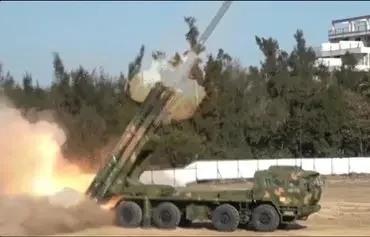
Chinese authorities published a map showing five large zones around Taiwan for the war games and released footage of PCH-191 long-range rocket launches, as Washington announced an $11 billion Taiwan arms package that includes High Mobility Artillery Rocket Systems (HIMARS).
Taiwan media have described the PCH-191 as a "Chinese HIMARS" because both fire guided rockets. Shu Hsiaohuang, a researcher at Taiwan's defense think tank, told local media the rockets are "less accurate than ballistic missiles" but cheaper and fielded in larger numbers, increasing pressure on Taiwan's air defenses.
Taiwan said some drill zones lay within 12 nautical miles of its coast, disrupting international shipping and aviation routes. Its Civil Aviation Administration said Taiwan had to cancel or delay hundreds of flights.
Stoic reaction
The Defense Ministry said on December 30 it detected at least 130 Chinese military aircraft and more than 50 vessels, including 27 navy ships. The coast guard said it deployed 14 ships, using a "one-on-one shadowing approach" to deter the vessels.
Taiwan's Military News Agency said forces conducted several drills in response to the Chinese exercise, including one in the Taipei area focusing on the deployment of river obstacles and rapid troop response.
Many ordinary Taiwanese reacted stoically.
"There have been so many drills like this over the years that we are used to it," said fishmonger Chiang Sheng-ming, 24, at a market in Taipei.
"If you stand your ground, there's nothing to be afraid of," added fruit seller Tseng Chang-chih, 80.
The second day of drills reinforces a broader escalation pattern, not episodic shows of force, say security analysts.
Analysts flag blockade trend
Beijing is intensifying "its efforts to isolate Taiwan" by targeting key partners, "particularly Japan and the United States," Jack Burnham of the Foundation for Defense of Democracies said.
China is moving toward a "de facto blockade" maintained by the China Coast Guard and backed by military force, he said. The United States and allies should respond "with equal clarity," including regional stockpiles and convoy planning, he suggested.
The drills show the PLA refining a layered blockade concept, not symbolism, say regional analysts.
"This is about striking fear and a sense of inevitability in Taiwanese hearts and minds," Alessio Patalano told the London Guardian on December 30, warning "more overtly aggressive steps might be normalized."
US President Donald Trump said he was not concerned about the drills, appearing to brush aside the possibility of Chinese counterpart Xi Jinping ordering an invasion of Taiwan.
"I don't believe he's going to be doing it," Trump said.
Tt