


By Zarak Khan |
India has commissioned a new stealth-guided missile frigate and a nuclear-powered ballistic missile submarine (SSBN). They strengthen India's naval capabilities in a move widely interpreted as a counter to China's growing maritime presence across the Indo-Pacific.
The induction of INS Taragiri, a Project 17A stealth frigate, alongside INS Aridhaman, the country's latest indigenous SSBN, highlighted a strategic shift in New Delhi's maritime doctrine toward deterrence and sustained blue-water operations.
Stealth edge
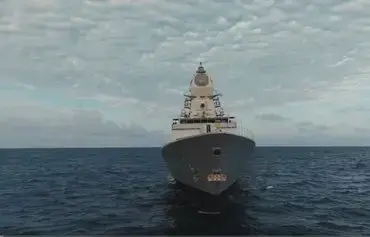
Commissioned on April 3 in Visakhapatnam, INS Taragiri represents one of India's most advanced surface combatants.
Built under the Project 17A program, the frigate incorporates stealth features designed to reduce its radar and acoustic signatures, enhancing survivability in contested environments.
Speaking at the commissioning ceremony, Defense Minister Rajnath Singh said the vessel is "capable of high-speed transit and can remain deployed at sea for extended periods," and "equipped with systems designed to monitor enemy movements, ensure its own security, and if necessary, deliver an immediate response."
The frigate has the supersonic BrahMos cruise missile system and modern surface-to-air missile platforms, alongside advanced radar and sonar suites, Singh said.
These capabilities allow it to conduct a wide range of missions, from high-intensity naval combat to maritime security, anti-piracy patrols and humanitarian operations.
Mazagon Dock Shipbuilders Limited, the state-run shipyard responsible for the vessel construction, said the vessel "substantially enhances India's surveillance capabilities and operational reach across the Indian Ocean Region."
Sea deterrence
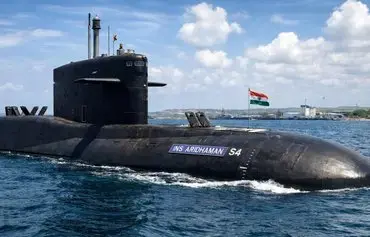
While INS Taragiri enhances surface capabilities, the INS Aridhaman, India's third indigenous SSBN, bolsters the country's underwater nuclear triad.
Also commissioned on April 3, the sub has "significantly bolstered the country's retaliatory capability against any adversary planning to conduct a first strike," The Federal reported April 4.
The development reinforces India's effort to ensure a credible second-strike capability, a cornerstone of its nuclear doctrine.
Measuring 125 meters long and displacing 7,000 tons, the submarine is larger and quieter than its predecessors, the 6,000-ton INS Arihant and INS Arighaat, which were commissioned in 2016 and 2024.
The vessel has a quieter "acoustic signature" than its sister subs do, Indian military analyst Shekhar Gupta said in April.
Its induction enabled India to maintain "a continuous at-sea deterrent with its SSBN fleet," WION reported April 3.
Additionally, its larger size and improved power and weaponry allow for more-flexible operations across the Indian Ocean, the report added.
China factor
The timing of these inductions highlights intensifying geopolitical competition in the Indo-Pacific, where China has expanded its naval presence in unsettling ways.
China is increasing "submarine patrols, carrier operations, and military access agreements across the Indian Ocean Region," Defense Security Asia said in an April 6 report.
"The simultaneous induction of a survivable sea-based nuclear deterrent and an advanced multi-role surface combatant signals that New Delhi is accelerating beyond symbolic fleet modernization toward an integrated maritime force structure," the study said.
India's latest platforms thus represent a direct response to mounting strategic pressure in its main maritime sphere of influence.
The commissioning reflects India's broader push toward defense self-reliance under the Aatmanirbhar Bharat initiative, which seeks to reduce dependence on foreign military suppliers while expanding domestic industrial capacity.
INS Taragiri incorporates more than 75% indigenous content, drawing on a supply chain that includes more than 200 domestic enterprises, supporting thousands of Indian jobs and reducing reliance on foreign suppliers, New Delhi says.
India's defense exports have surged to almost 390 billion INR ($4.2 billion) in the 2025–26 fiscal year, compared with just 12 billion INR ($128.9 million) a decade earlier, according to government data.
"This is proof that India's self-reliance is growing steadily," Singh, the defense minister, said.
"India's oceans are guarded by ships designed by Indians, built by Indians, and operated by Indians," the Defense Ministry said in a statement.
H