


By AFP and Li Hsien-chi |
HONG KONG -- After four months of restless waiting, filmmaker Kiwi Chow received a dreaded, but not altogether unexpected, message in December. Hong Kong censors had banned his new movie from reaching the big screen, saying it could be "detrimental to national security."
The 46-year-old's career, which took off in 2015 with an award-winning dystopian tale, "Ten Years," encapsulates how a film industry once known for its audacious spirit and sardonic humor has dimmed to leave artists describing a creative straitjacket.
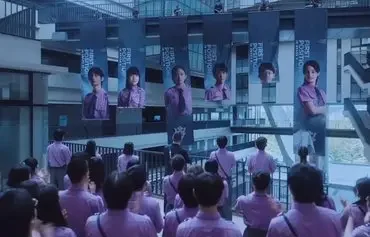
His latest thriller, "Deadline," tells the story of an elite school rattled by warnings of an impending suicide, Chow told AFP, describing the work as an allegory for hyper-competition under capitalism. Hong Kong announced the ban in December, he said.
The movie was filmed in Taiwan but set in what Chow called an "imaginary world."
![Hong Kong film director Kiwi Chow poses for a portrait during an interview at his office December 17. His latest film, 'Deadline,' was recently banned by Hong Kong authorities. [AFP]](/gc9/images/2026/01/09/53420-afp__20251222__88e34gp__v6__highres__correctionhongkongchinacensorshipfilm-370_237.webp)
"(Censors) determined that it was 'contrary to the interests of national security'... But how? Nobody gave an explanation," the director said.
Chow wrote on Facebook that the ruling, based on the National Security Law passed in 2020, was "absurd, excessive, crude and unjust."
Censorship climate
Beijing imposed the stringent national security law on Hong Kong in 2020 after huge and sometimes violent pro-democracy protests in the finance hub. It tightened film censorship rules a year later.
After that, Chow said, the film industry stepped up self-censorship.
"If it involves Hong Kong's real political situation, absolutely no one will make a movie about it," he said.
Asked about "Deadline," the Hong Kong Office for Film, Newspaper and Article Administration said it would not comment on individual applications.
Censors banned 13 films, citing national security reasons, between 2021 and July this year, while 50 films were "required to be modified," the office told AFP.
Hong Kong banned no films between 2016 and 2020, but that figure jumped to 10 in 2023.
Chow said that authorities rejected his film not because of its content but because his years flouting Beijing's taboos have put him on an informal blacklist.
"I want to collaborate with actors, seek out locations and investors, but it is very difficult," he said.
"I felt so lonely," he said of making "Deadline."
Decade in hindsight
Chow made his name a decade ago with "Ten Years," which depicts a dystopian Hong Kong in the then-distant 2025.
On December 17, 2015, the film premiered in Hong Kong and showcased five pessimistic vignettes -- including one directed by Chow -- at a time when many residents feared Beijing's growing political influence in the semi-autonomous city.
Speaking to AFP exactly 10 years later, Chow recalled how crowds flocked to community screenings after some mainstream cinemas refused to show the film.
"Many people felt that 'Ten Years' depicted Hong Kong's predicament ... and how freedoms could be lost. (They felt) this was prophesied in the film, and it came true," Chow said.
Chow's segment of the film, titled "Self-immolator," ends with a fictional elderly woman dousing herself in gasoline and flicking a lighter.
"The self-immolator was a symbol of sacrifice. I wanted to ask Hong Kongers: 'How much are you willing to sacrifice for values like freedom and justice?'" he said, adding that his ideas on sacrifice are shaped by his Christian faith.
He said he got his answer during the 2019 pro-democracy protests, which were unprecedented in scale and ferocity and led to more than 10,200 arrests and more than 2,000 people sanctioned by law.
In 2019, Chow was near the end of the production cycle of a romantic drama film, but he also shot extensive footage of the protests that would become the documentary "Revolution of Our Times."
The documentary premiered at the Cannes Film Festival in July 2021, but Chow never tried to screen it in Hong Kong and kept the entire production team anonymous.
"After making 'Revolution of Our Times,' I expected not to be able to make movies for quite a long time, and was mentally prepared to go to jail," he said.
'Risk'
While the documentary did not land Chow in prison, the filmmaker said he paid a steep price as investors and collaborators deserted him, almost dooming "Deadline."
Chow said he could not secure a single Hong Kong school as a filming location, prompting him to move the production to Taiwan, where the film was released in November.
The long-awaited Hong Kong censorship decision came as a blow, particularly for the film's commercial prospects.
After the Hong Kong ban, Chow said the film had been selected for the 55th International Film Festival Rotterdam in the Netherlands.
Some of Chow's supporters in Hong Kong travelled to Taiwan for special screenings of "Deadline," though one organizer said he was searched by customs upon his return.
Hong Kong customs declined to comment on individual cases.
Chow did not want to "abandon" his city despite feeling that political censorship was creating headwinds for his work.
"The government took an official stance that this film was contrary to the interest of national security, which could be a first (for me), and adds some level of risk and anxiety," Chow said.
"May justice come to Hong Kong. I believe God will not abandon the city, nor will I," he said.