


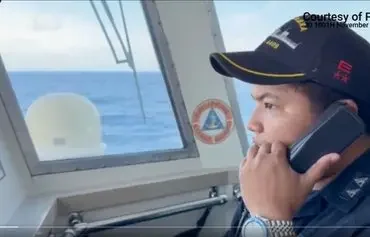
![Philippine coast guard (PCG) vessel BRP Cabra (not shown) confronts China Coast Guard ship CCG-21562 during an encounter in waters off Zambales on November 30, as the PCG says it is challenging what it calls an illegal Chinese presence in Philippine waters. The Cabra monitored 3 Chinese ships in the incident. [PCG]](/gc9/images/2025/12/16/53161-pcg-370_237.webp)
By Liz Lagniton |
The Philippine coast guard has stepped up efforts to challenge Chinese coast guard vessels operating off Zambales province, pushing back against what Manila calls illegal incursions into Philippine waters.
The BRP Cabra has repeatedly moved to block the advance of larger Chinese ships while maintaining radar watch on other vessels operating in the same area, the coast guard says. Another standoff on November 30 occurred about 88 nautical miles from Palauig Point in Zambales province. Three Chinese ships were involved.
Commodore Jay Tarriela, the Philippine coast guard's spokesperson on West Philippine Sea issues, described the Chinese presence as an "illegal incursion into Philippine sovereign waters." In a statement posted on X on November 30, Tarriela said the BRP Cabra issued repeated radio challenges while standing guard within the Philippine Exclusive Economic Zone (EEZ).
The West Philippine Sea is Manila's name for the part of the South China Sea inside the Philippine EEZ.
The Chinese ships are significantly larger and more heavily armed than the Philippine patrol vessel, a disparity that has become a recurring feature of encounters in the South China Sea in recent years.
The BRP Cabra nevertheless kept the Chinese ships from breaching the EEZ, said Tarriela.
Since November 23, the coast guard has carried out coordinated shadowing operations with the BRP Cabra and the BRP Teresa Magbanua. The sustained patrols, the agency said, are intended to show that Philippine ships will contest foreign presence rather than yield ground by default.
Chinese violations and harm to Filipinos
Philippine officials say the continued deployment of Chinese vessels off Zambales violates a range of legal frameworks governing maritime conduct. The coast guard cites the Philippine Maritime Zones Act, the United Nations Convention on the Law of the Sea (UNCLOS) and the 2016 arbitral ruling that debunked China's sweeping claims over much of the South China Sea.
"The Philippine Coast Guard remains steadfast in defending our sovereign rights and maritime jurisdiction," Tarriela said, adding that the agency "will not tolerate any attempt to unilaterally alter the status quo along the Luzon coastline through encroachment."
Beyond legal arguments, the standoff has tangible consequences for local communities. Zambales is home to fishing towns that depend on access to traditional fishing grounds within the EEZ.
Local fishers have repeatedly reported being driven away, shadowed or closely monitored by large foreign vessels, experiences that fuel anxiety over food security and lost income.
Philippine officials point to a Chinese pattern of close encounters and interference with fishing and garrison resupply missions in recent years, which they say increases the risk of escalation even absent open conflict.
Visible patrols serve both as a legal assertion and as reassurance to coastal residents that the state is actively defending access to maritime resources recognized under international law, say Philippine coast guard officials.
The standoff is part of a wider struggle over the West Philippine Sea. In recent months, Beijing has increasingly portrayed Manila as a "troublemaker," while Philippine officials have framed China's operations as coercive attempts to erode maritime rights through sustained presence.
Constant 'gray-zone' coercion
Security analysts describe the Chinese behavior as "gray-zone" coercion: actions that apply pressure without crossing into open conflict, including persistent patrols, close shadowing and efforts to assert de facto control through intimidation rather than through force.
An analysis in November in the Diplomat described the approach as "lawfare," saying that China is pairing legal narratives with operational activity to challenge Philippine positions and justify stricter Chinese enforcement.
China may be seeking to "normalize archipelagic transit passage where there wasn't any before," so that it can frame new pathways as ordinary routes for international navigation and overflight and fold the incidents into disputes over Philippine sea-lane designations, Jacqueline Espenilla, a University of the Philippines law professor and a fellow in maritime law, wrote.
Broad, nonspecific accusations of Philippine "provocation" help muddy legal questions and consume time and resources, even as Manila cites UNCLOS and the 2016 arbitral award, said Espenilla.
The award remains final and binding, and China's posture off Luzon and elsewhere is aimed at normalizing a presence that the Philippines considers unlawful, Manila says.
China's sweeping claims and coercive behavior "undermine regional stability and fly in the face of its prior commitments to resolve disputes peacefully," US State Department spokesman Thomas Pigott said October 13.